A Global War
World War I was fought in Europe, Asia, Africa, and the Pacific and Atlantic Oceans. Not since the Seven Years’ War of the late 18th century had there been such a global war. Most of the major combatants in World War I ruled colonies in Asia, Africa, the Americas, and the Pacific. Competition for these colonies was one major reason for war. Imperialism extended the boundaries of the war, and major battles were fought in North Africa and the Middle East. Japan entered the war on the side of the Allies so that it could take control of German colonies in the Pacific—the Marshall Islands, the Mariana Islands, Palau, and the Carolines. Japan also occupied Tsingtao (Qingdao), a German- held port in China.
The British seized most of Germany’s colonies in Africa. However, the Germans held on to German East Africa, later called Tanzania. The British also defended the Suez Canal from an attack by the Ottoman Empire.
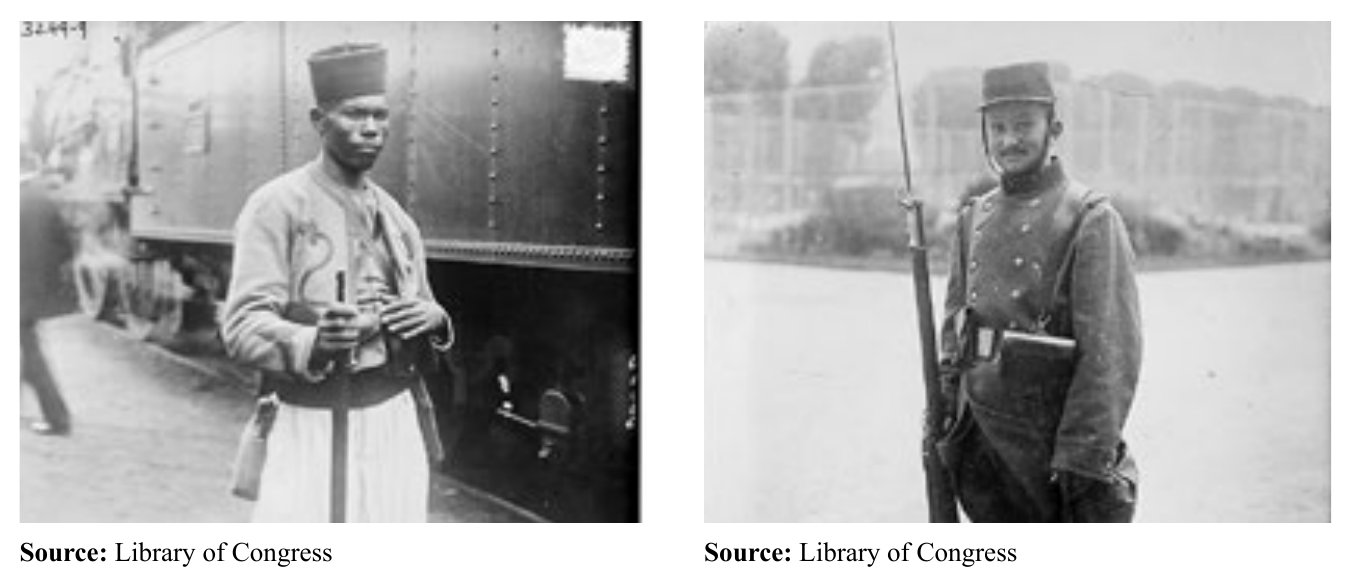
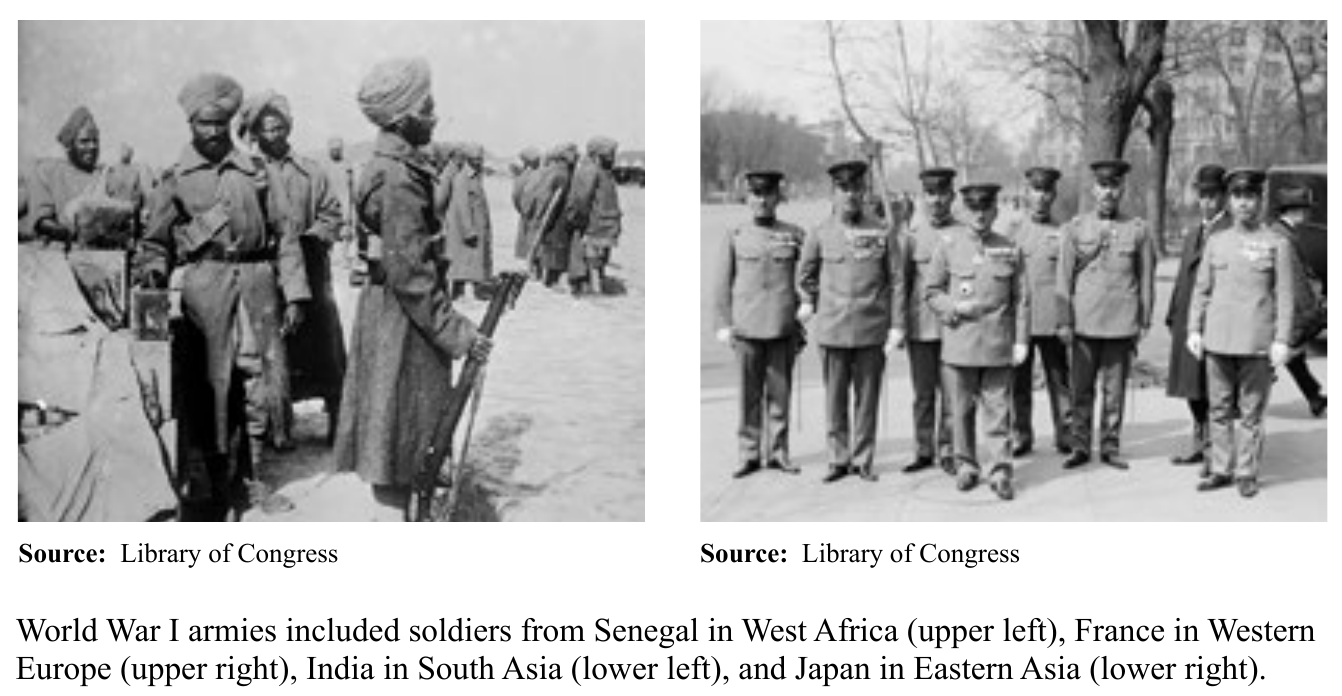
Colonial troops reinforced their home countries’ forces in several battles. About half a million Australians and New Zealanders enlisted to fight the war. These troops formed a special corps known as ANZAC and fought in a bloody year-long campaign at Gallipoli, a peninsula in northwestern Turkey, that resulted in heavy Allied losses with little to show for the effort. Canadian troops fought in several European battles. Britain drafted Africans and Indians for combat roles in Europe. Some 90,000 Gurkha soldiers from Nepal fought in the Indian Army. Approximately 1.3 million soldiers served in the Indian Army during the war, in Europe and Southwest Asia. The French Army included 450,000 Africans, mostly from West Africa and Algeria, as well as another 110,000 Europeans from North Africa. Some 44,000 Indochinese soldiers fought in the French army, with nearly 50,000 more working in support roles behind the lines. Some colonial troops fought in hopes that their efforts would gain them recognition from their colonizers, who often promised the colonies self-rule after the war ended.
Arabs, long under the rule of the Turkish-led Ottoman Empire, fought with the Allies because the British promised self-rule after the war if they were victorious. Arab troops attacked Ottoman forts in Arabia and present-day Israel and helped the British take over the cities of Baghdad, Damascus, and Jerusalem.
Women and the War In the early 20th century, most countries did not allow women to vote or to be soldiers. However, the sheer numbers of men enlisting meant that women’s lives changed significantly. They began replacing those men on farms and in factories. Thousands of women served on the front lines as nurses, ambulance drivers, and switchboard operators.
Most countries forebade women from serving in combat, but Russia, Serbia, Romania, and Bulgaria allowed it. In 1917, the Russian government created an all-female battalion (military unit) as propaganda to shame men into continuing to fight. The commander Maria Bochkareva led the First Russian Women’s Battalion of Death.