The Non-Aligned Movement
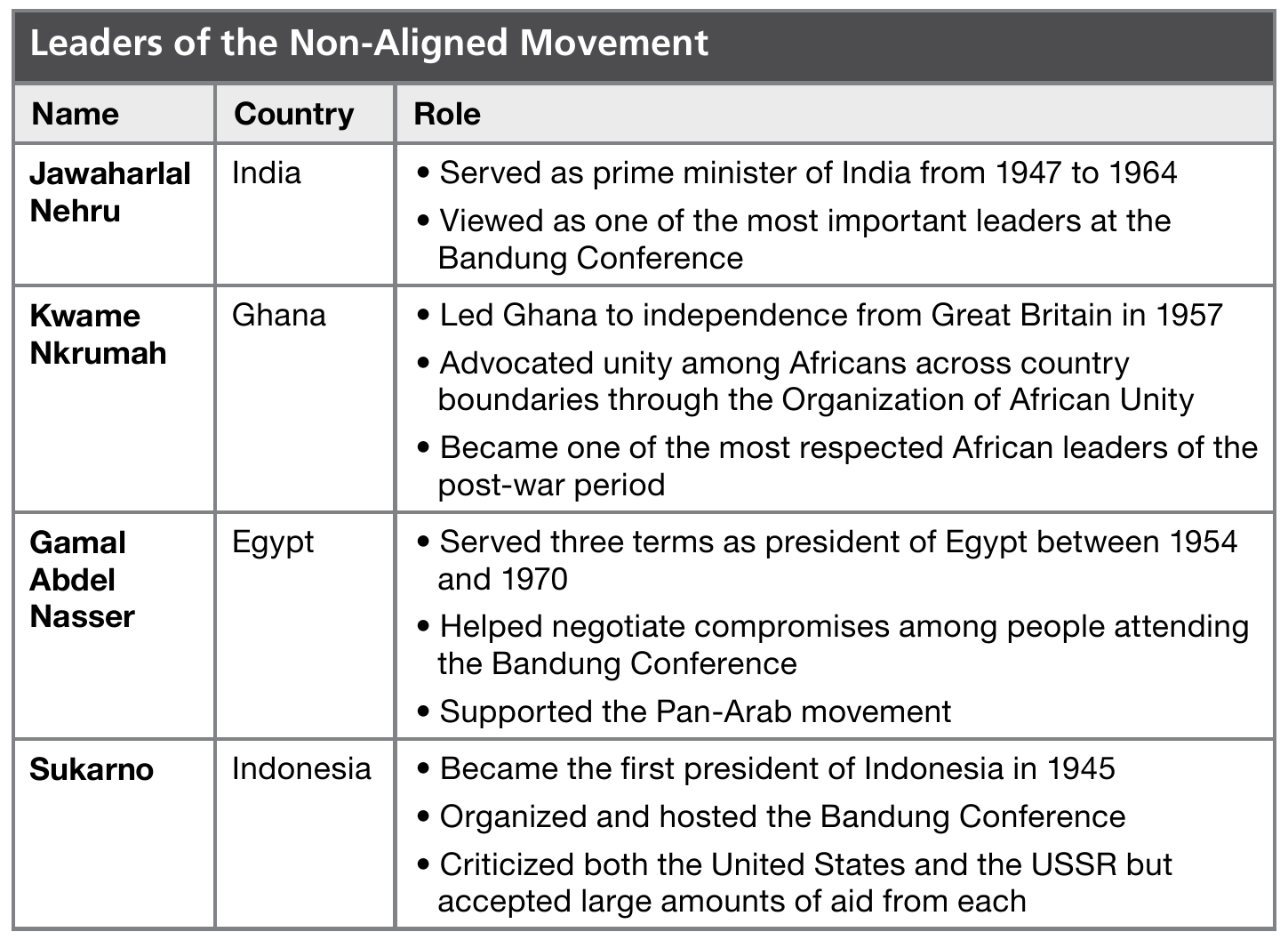
Many new African and Asian countries wanted to stay out of the U.S.-Soviet Cold War. They wanted an alternative framework for international economic, political, and social order—one not dominated by the two superpowers. In 1955, Indonesia hosted a conference, known as the Bandung Conference after the city where it was held, for representatives of these countries. Delegates from China, India, and 27 other countries—representing more than half the world’s population—passed resolutions condemning colonialism. The impulse that prompted the Bandung Conference led countries to formally organize the Non- Aligned Movement in 1961. However, non-aligned countries faced challenges:
• Member states tried to combine support for stronger international institutions with efforts to advance their own interests. For example, Indian leader Jawaharlal Nehru supported a stronger UN, but he opposed its efforts to intervene in the conflict between India and Pakistan over control of the region of Kashmir.
• Member states often became more closely allied with one superpower or the other. When war broke out between Somalia and Ethiopia in 1977, the Soviet Union supplied aid to Ethiopia, prompting the United States to supply aid to Somalia.