Unit 4 AP Exam Practice
Document-Based Questions
1. Develop an argument that evaluates the extent to which states managed to consolidate and expand their power during the period 1450 to 1750.
Document 1
Document 1
Source: The Tokugawa Shogun, Toyotomi Hideyoshi, The Edicts of Toyotomi Hideyoshi: Excerpts from Collection of Swords, 1588
1. Farmers of all provinces are strictly forbidden to have in their possession any swords, short swords, spears, firearms, or other types of weapons. If unnecessary implements of war are kept, the collection of annual rent (nengu) may become more difficult, and without provocation [prompting] uprisings can [occur]. Therefore, those who perpetrate improper acts against samurai who receive a grant of land (kyuˉ nin) must be brought to trial and punished. However, in that event, their wet and dry fields will remain unattended, and the samurai will lose their rights (chigyoˉ ) to the yields from the fields. Therefore, the heads of the provinces, samurai who receive a grant of land, and deputies must collect all the weapons described above and submit them to Hideyoshi’s government.
2. The swords and short swords collected in the above manner will not be wasted. They will be used as nails and bolts in the construction of the Great Image of Buddha. In this way the farmers will benefit not only in this life but also in the lives to come.
3. If farmers possess only agriculture implements and devote themselves exclusively to cultivating the fields, they and their descendants will prosper. This compassionate concern for the well-being of the farms is the reason for the issuance of this edict, and such concern is the foundation for the peace and security of the country and the joy and happiness of all the people.
Document 2
Document 2
Source: Letter from the Spanish General, Don Alonzo del Campo y Espinosa to Henry Morgan, Admiral of the Buccaneers. Morgan was an English privateer, 1669. Privateers were sea captains who were given permission by the English government to raid Spanish ports and ships to acquire gold and other commodities.
Having, through our friends and neighbors, received news that you have had the audacity [boldness] to commit hostilities in the territories and cities owing obedience to His Catholic Majesty, the king of Spain my master, I have come to this place, according to my bounden duty, and have built up again that fortress which you took from a set of faint-hearts and from which you flung down the guns, that I may prevent your escape from this lake and do you all the injury my duty requires.
Nevertheless, if you will surrender with humility all which you have taken, including all the slaves and other prisoners, I will have the clemency to let you pass, that you may return to your own country.
Should you [stubbornly] resist these honorable conditions which I propose, I shall send for sloops from Caracas*, in which I shall embark my troops to sail for Maracaibo, with orders to destroy you utterly and put every man to the sword. This is my final resolution: take heed, and be not ungrateful for my kindness. I have with me valiant soldiers, yearning to be allowed to revenge unrighteous acts you have committed against the Spanish nation in America.
*Caracas was the capital of the Spanish Empire’s Venezuela Province.
Document 3
Document 3
Source: The Twelve Articles of the Swabian Peasants, a list of grievances drawn up by a group of peasants during the German Peasants’ War (or Great Peasants’ Revolt), 1524 to 1525. Drafted by two religious leaders, Sebastian Lotzer and Christoph Schappeler, in the German city of Memmegen between February 27 and March 1, 1525.
The Third Article. It has been the custom…for men to hold us as their own property…Accordingly it is consistent with the Scripture that we should be free and should wish to be so. Not that we would wish to be absolutely free and under no authority…We would gladly observe all this as God has commanded us in the celebration of the communion. He has not commanded us not to obey the authorities, but rather that we should be humble, not only towards those in authority, but towards every one. We are thus ready to yield obedience to God’s law to our elected and regular authorities in all proper things becoming to a Christian. We therefore take it for granted that you will release us from serfdom as true Christians, unless it should be shown from the gospel that we are serfs.…
The Seventh Article. Seventh, we will not hereafter allow ourselves to be further oppressed by our lords, but will let them demand only what is just and proper according to the word of the agreement between the lord and the peasant.…
The Ninth Article. In the ninth place, we are burdened with a great evil in the constant making of new laws. We are not judged according to the offense, but sometimes with great ill-will, and sometimes too leniently. In our opinion, we should be judged according to the old written law, so that the case shall be decided according to its merits, and not with partiality [bias].
Document 4
Document 4
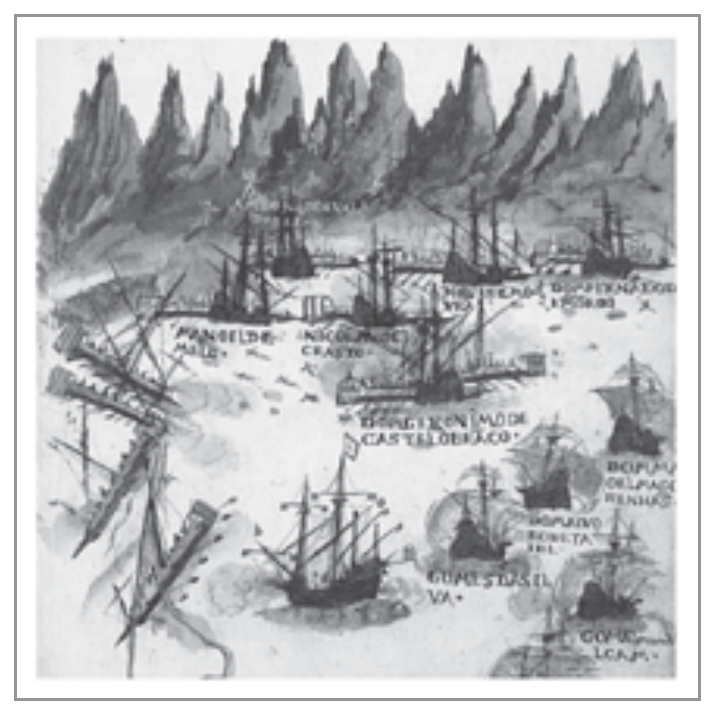
Source: The Ambush of Seydi-Ali (August 1544), from the Livro de Lisuarte de Abreau, written between 1558 and 1565. The drawing shows the defeat of an Ottoman naval fleet under the command of Seydi-Ali by a Portuguese naval fleet in the Gulf of Oman in the Indian Ocean.
Document 5
Document 5
Source: Friedrich Schiller, late 18th century German historian, excerpt from his book The Thirty Years War (1799). The Thirty Years War was fought from 1618 to 1648.
Religion alone could have rendered possible all that was accomplished, but it was far from being the sole motive of the war. Had not private advantages and state interests been closely connected with it, vain and powerless would have been the arguments of theologians; and the cry of the people would never have met with princes so willing to espouse [support] their cause, nor the new doctrines have found such numerous, brave, and persevering champions…Princes fought in self-defense or [to increase their own power], while religious enthusiasm recruited their armies, and opened to them the treasures of their subjects. Of the multitude who flocked to their standards [agreed to fight for them], such as were not lured by the hope of plunder [stolen riches], imagined they were fighting for the truth, while in fact they were shedding their blood for the personal objects of their princes.
Document 6
Document 6
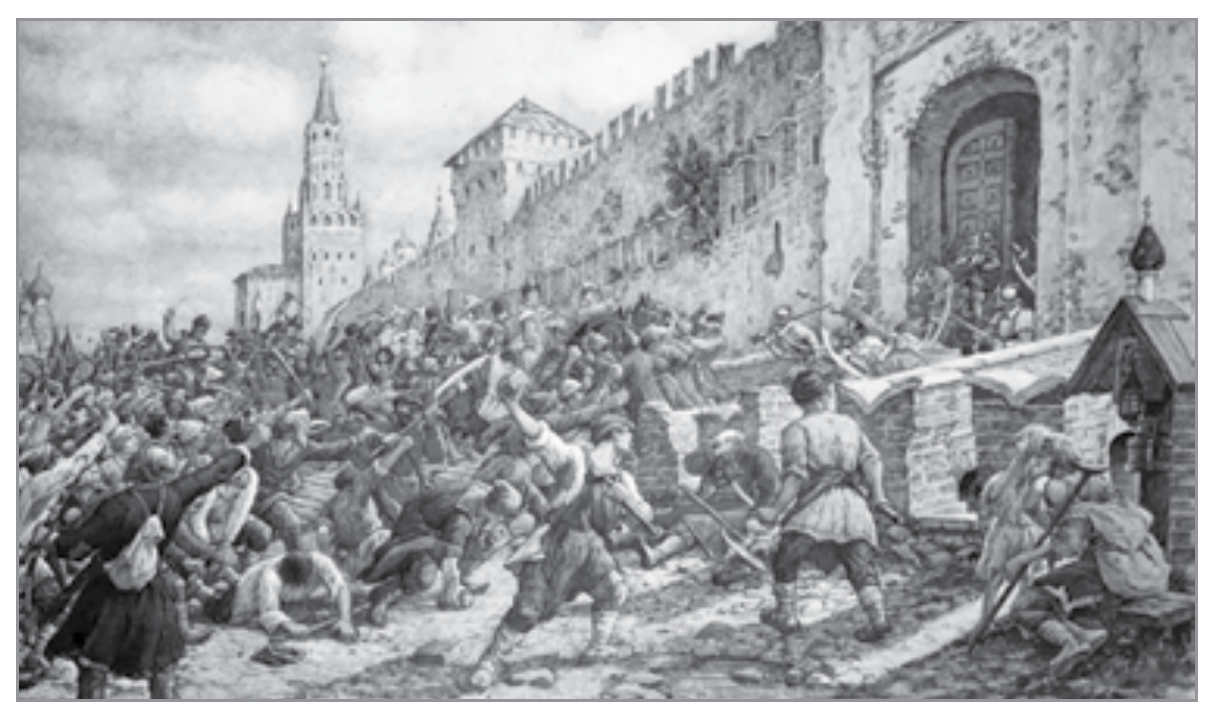
Source: Painting of the Salt Riot in Moscow, 1648, Ernest Lissner, 1938. This painting depicts the violent riots by artisans and serfs against Czar Alexei I’s government over the implementation of a universal tax on salt.
Document 7
Document 7
Source: Letters of Ogier Ghiseline de Busbecq, a Flemish writer and ambassador of the Austrian Empire to the Ottoman court of Suleiman the Magnificent, 1554–1562.
Solyman [i.e. Suleiman the Magnificent] at one time tried persuasion on the Shah [i.e. the Safavid Shah Tahmasp I], reminding him of the treaty, by which he had agreed they should both have the same friends and enemies, and at another, endeavored to frighten him with menacing language and threatened him with war…He [Sulieman] had placed strong garrisons in all his towns on the Persian [i.e. Safavid] frontier, and filled Mesopotamia and the bank of the Euphrates with soldiers, who were taken for the most part from the Imperial guard…He also sent frequent messages to the tribes they call the Georgians [people of the Caucus region of Eurasia], who dwell between the Caspian and the Black Sea, and border on Media, urging them to take up arms against the King of Persia…In another direction are still to be found five Turkoman chiefs descended from Tamerlane; and these also were invited to join their arms against the common foe.
Long Essay Questions
1. In the period from 1450 to 1750, trans-Atlantic trade brought new inventions and ideas to societies in the Eastern and Western hemispheres.
Develop an argument that evaluates the extent to which cross-cultural interactions resulted in the diffusion of technology and helped cause changes in patterns of trade and travel during that era.
2. Strong central governments, mercantilism, and trading enslaved people all shaped Europeans’ transoceanic explorations from 1450 to 1750.
Develop an argument that evaluates the extent to which economic systems and labor systems showed continuities or changes over time during that period.
3. The Columbian Exchange brought riches to Europe from 1450 to 1750, but it also brought misery to the Americas and Africa.
Develop an argument that evaluates the extent to which the systems of slavery in that era showed changes or continuities over time.
4. A desire to convert others, the development of syncretic belief systems, and religious conflicts changed the Americas, Africa, and Eurasia from 1450 to 1750.
Develop an argument that evaluates the extent to which the effect on societies of various belief systems was similar or different during that time period.