Topic 1 AP Exam Practice
Multiple-Choice Questions
Questions 1 to 3 refer to the image below.
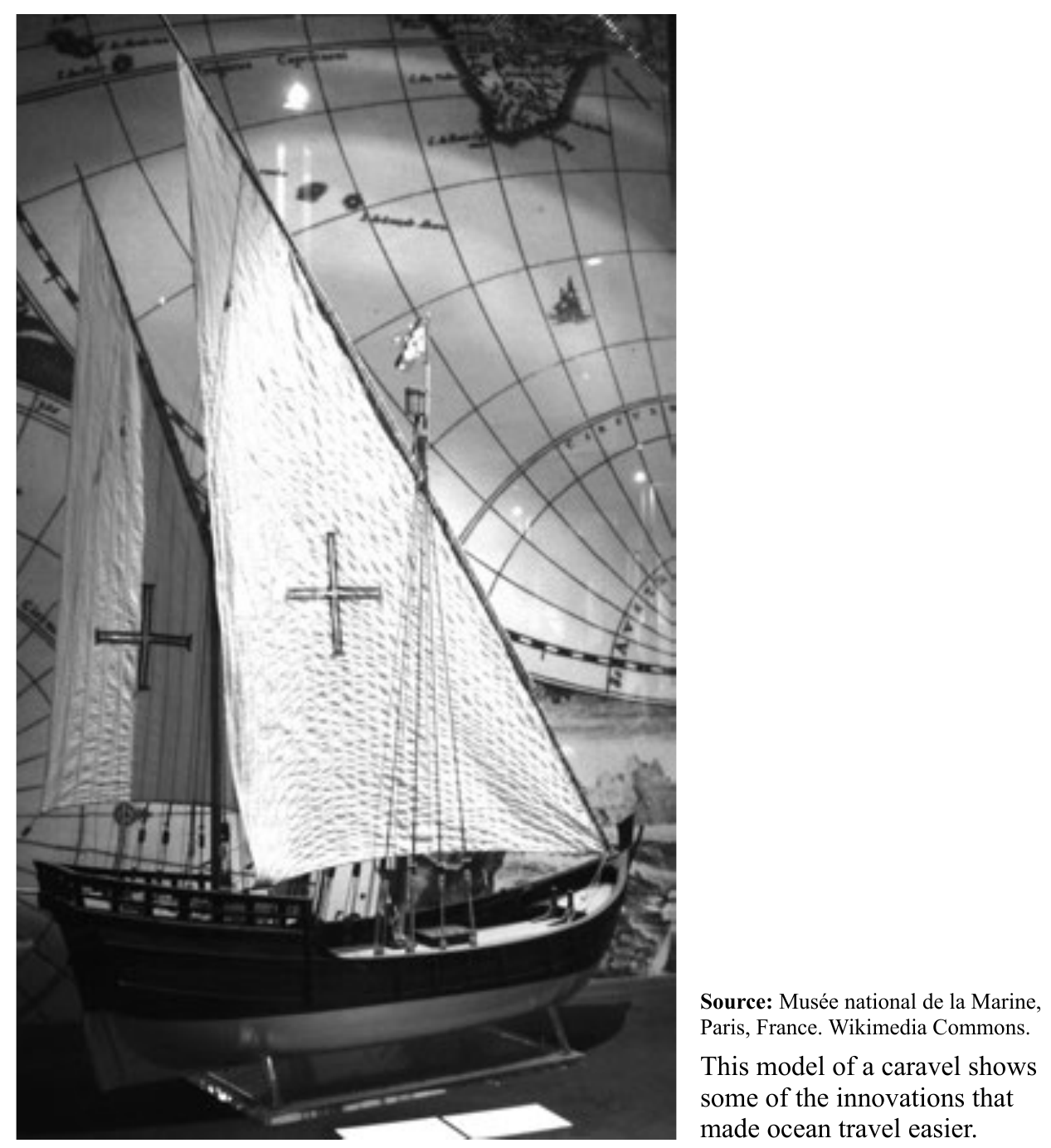
1. The specific technological innovation depicted here that improved deep water navigation was the
- (A) compass
- (B) upper deck oars
- (C) astrolabe
- (D) lateen sails
2. The technological innovation depicted in the above image was first used in
- (A) the Black Sea
- (B) the East African coastal city of Kilwa
- (C) Constantinople
- (D) the Indian Ocean
3. The European monarch who made the greatest use of this new technology was
- (A) Prince Henry
- (B) Henry VIII
- (C) Mehmed the Great
- (D) Pope Urban II
Short-Answer Questions
1. Use the passages below to answer all parts of the question that follows.
“After the year 1500 there was no pepper to be had at Calicut that was not dyed red with blood.”
Voltaire, 1756
“Gunpowder weapons were not new. The Chinese invented gunpowder and they made the first true guns in the tenth century, primarily for defensive purposes. The Mongols improved these Chinese weapons into a more effective offensive force, to blow open city gates. By 1241, these weapons had reached Europe. Early modern Europeans, Turks, Mughals, and Chinese owed their strength in part to improvements in gunpowder weaponry. Combined with better military organization and seagoing capability, advanced weaponry inevitably affected political and social systems.
As they spread throughout Eurasia and North Africa, gunpowder weapons changed warfare. Europeans learned how to make particularly deadly weapons, improving the technology in part because they had easier access to metals.”
Craig A. Lockard, Societies, Networks, and Transitions: A Global History,Volume II: Since 1450 ( 2010)
2. Answer all parts of the question that follows.