Topic 2 AP Exam Practice
Multiple-Choice Questions
Questions 1 to 3 refer to the table below.
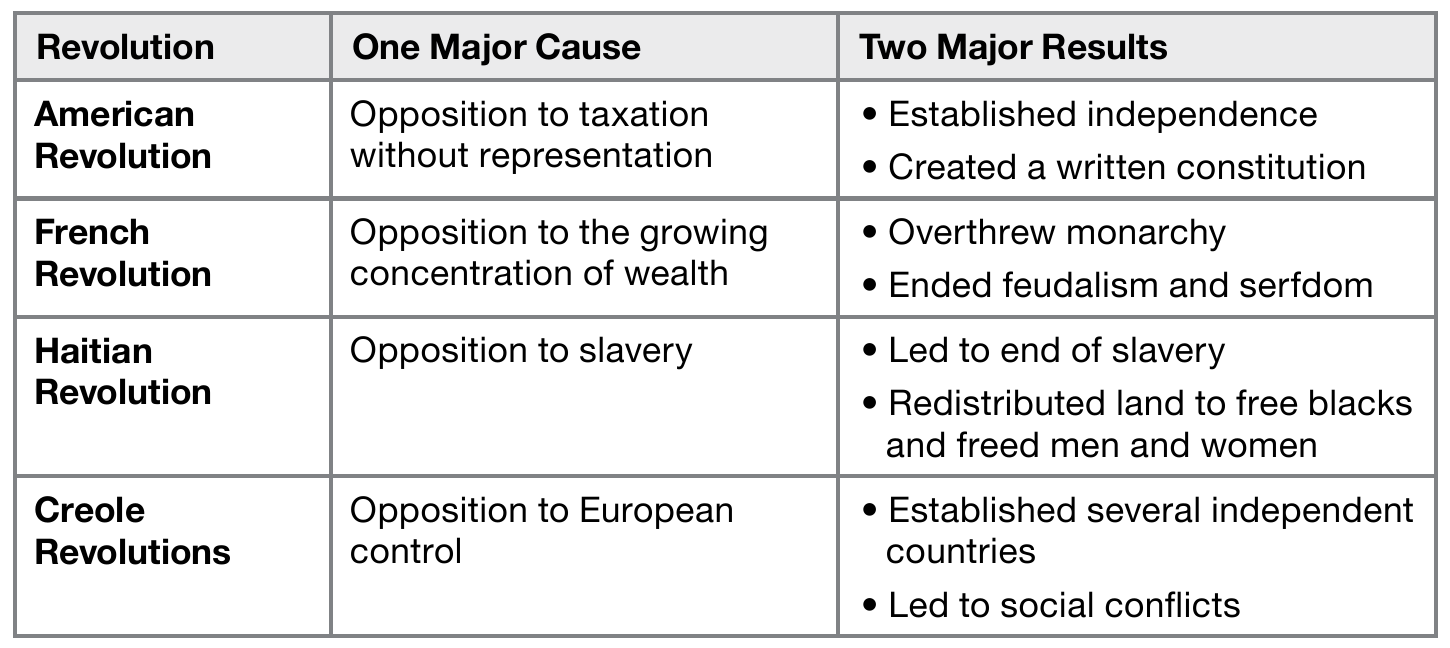
1. How were the Creole Revolutions not like the American, French, and Haitian Revolutions?
- (A) The Creole Revolutions were mostly against Spain.
- (B) The Creole Revolutions united all social classes.
- (C) The Creole Revolutions occurred more quickly.
- (D) The Creole Revolutions were the only ones that succeeded.
2. Which revolution most directly addressed the unequal distribution of economic opportunity and resources?
- (A) American
- (B) Haitian
- (C) French
- (D) Creole
3. Which generalization applies to all the revolutions listed in the table?
- (A) All resulted in newly independent countries.
- (B) All advocated racial equality.
- (C) All were reversed within a generation of their completion.
- (D) All were inspired by Enlightenment ideals.
Short-Answer Questions
1. Use the passage below to answer all parts of the question that follows.
“We are not European; we are not Indian; we are but a mixed species of aborigines and Spaniards. Americans by birth and Europeans by law, we find ourselves engaged in a dual conflict: we are disputing with the natives for titles of ownership, and at the same time we are struggling to maintain ourselves in the country that gave us birth against the opposition of the invaders.”
Simón Bolívar, speech to the Council of Angostura, 1819
2. Answer all parts of the question that follows.