Comparisons in the Classical Age
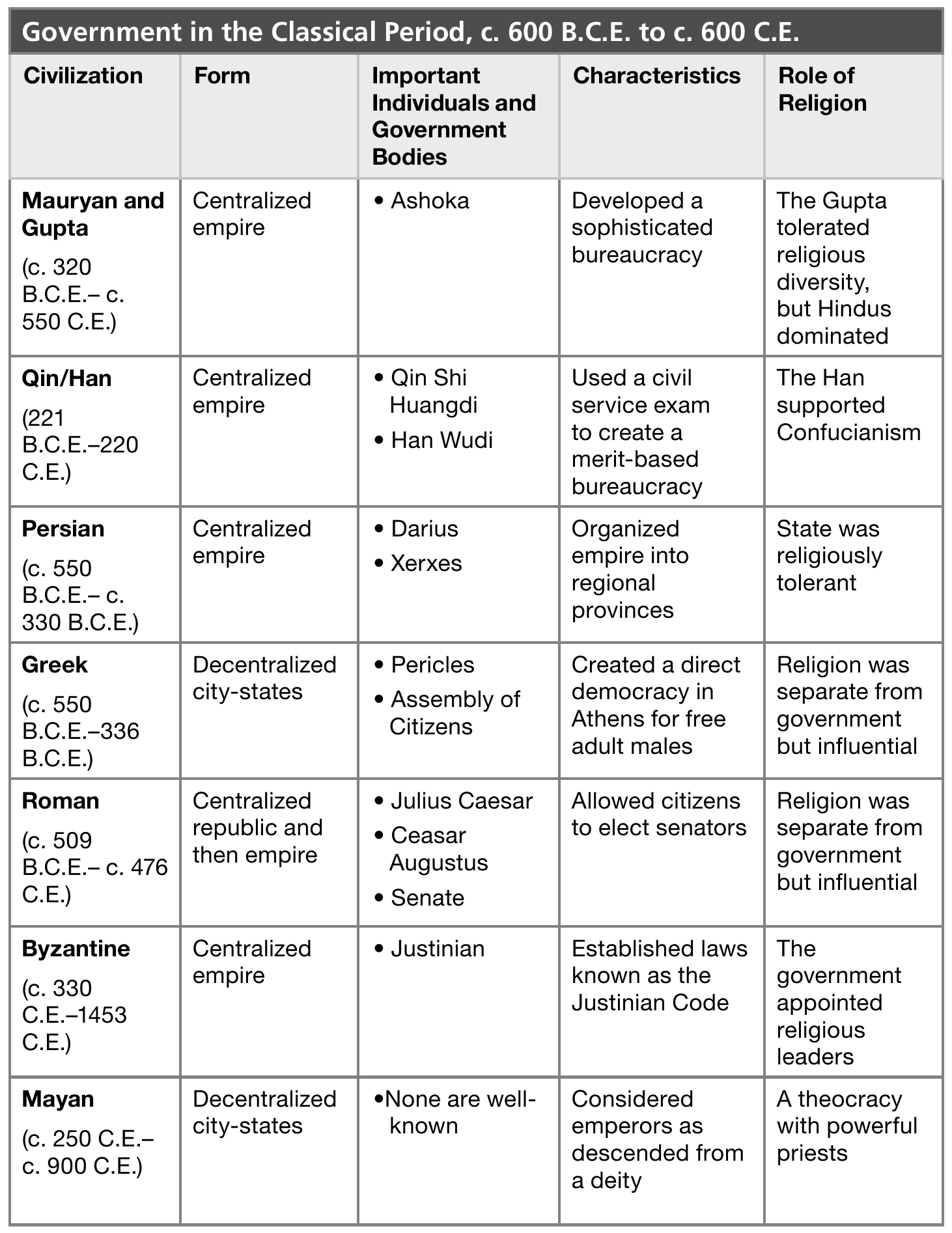
The empires that emerged between 600 B.C.E. and 600 C.E. shared several traits in economics and politics. In general, increased trade, technological innovation, and centralized government worked together to make the lives of people longer, safer, and more comfortable. In general, the empires also shared similar reasons for their decline.
Early Trade Networks As technological developments made trade easier, strong and stable governments provided the wealth and security to foster and sponsor trade. The Eurasian exchange networks utilized the strength of the Roman and Han innovations, such as stirrups that made riding horses easier and networks of places to rest and eat that made long journey travel more dependable.
Other key technologies included the improvements in sail design and ship hulls that enabled ships to maneuver in less than favorable wind conditions. The knowledge of monsoon winds facilitated trade along the entrepôts in the Indian Ocean. The improvements to the camel saddle made caravan trade profitable and possible across the Sahara.
The Mediterranean Sea lanes continued to facilitate cultural exchange and goods between the Phoenicians, Greeks, Romans, and people of North Africa. Long-distance trade was only beginning to hit its stride. These developments ushered in the first Golden Age of the Silk Roads.
Decline of Classical Empires By 600 C.E., many of the great classical empires were losing or had lost their unity and political power. As a result, people faced growing problems that they could not agree on how to address. Each unsolved problem then made peace and prosperity more precarious:
• challenges collecting taxes weakened government
• declines in trade decreased access to foreign goods and markets
• spread of disease reduced urban populations
• increases in the gap between the rich and poor created social conflict
• lack of broad support for leadership made solving problems harder
• attacks by outside groups led to a need for more spending on defense
In some areas, the spread of a common religion helped keep society unified even as a government failed. In later centuries, this unity would help new empires arise. For example, in Europe, the Roman Empire broke apart in the 5th century, but Christianity held society together. Confucianism filled a similar role in China, while Hinduism and Buddhism did the same in South Asia.