Ottoman Industrialization
Suffering from problems of overexpansion and failure to modernize, the Ottoman Empire underwent palace coups, declining trade, and weakening leadership in the 1800s. The empire no longer covered the grand areas of Suleiman the Magnificent, who had taken his army to the gates of Vienna in 1529.
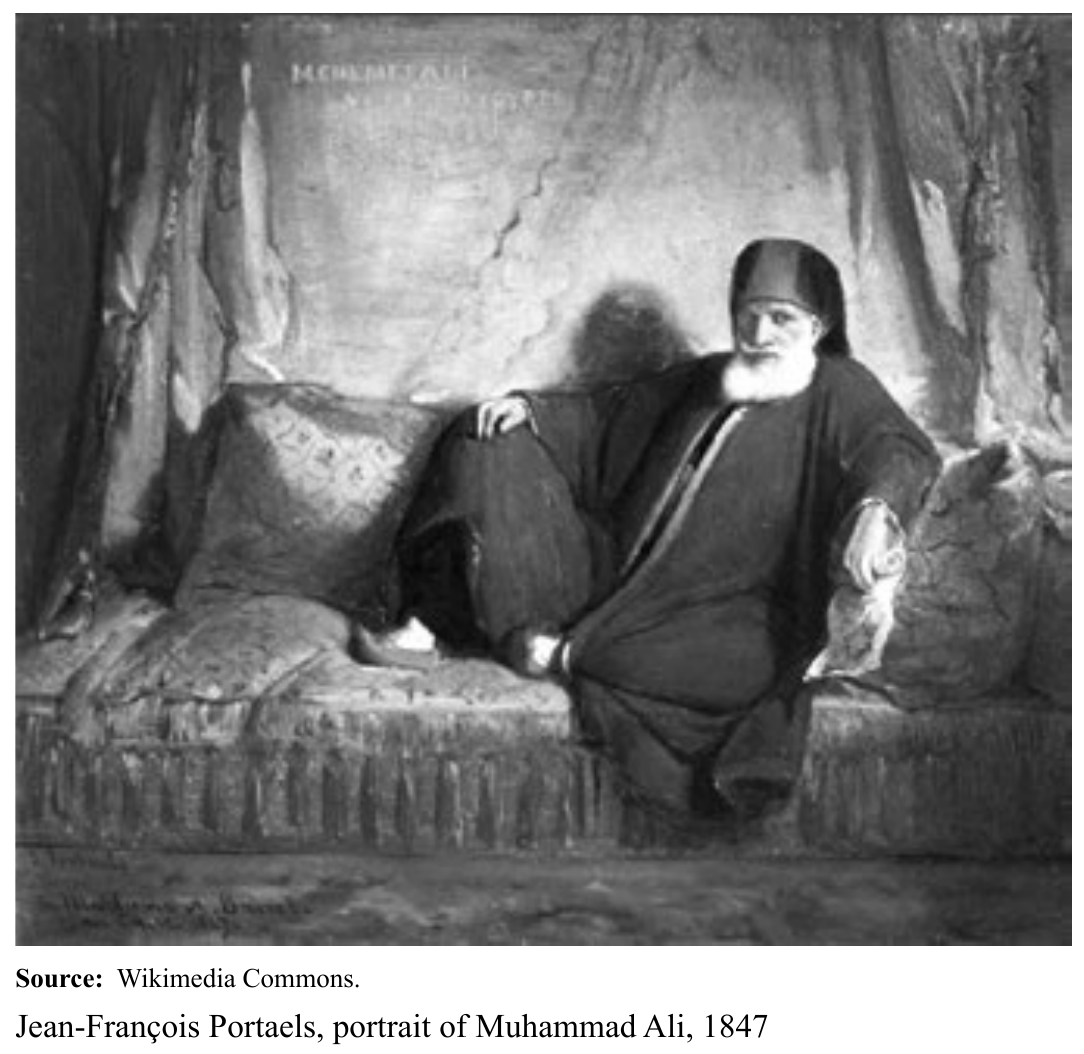
The Rise of Muhammad Ali One part of the Ottoman Empire where the sultan ruled in name but had little power was Egypt. In fact, the Mamluks, formerly enslaved Turks who formed a military class, had ruled there for some 600 years. In 1801, the sultan sent an Ottoman army to retake Egypt. In the conflict with the Mamluks, an Albanian Ottoman officer, Muhammad Ali, rose to prominence, and local leaders selected him to be the new governor of Egypt. The sultan lacked the power to do anything but agree.
Because of his power, Ali was able to act somewhat independently of the sultan. He joined the sultan’s military campaigns when it benefited him, and also undertook several campaigns without the sultan’s permission, including in the Sudan and Syria. He also began his own reforms in Egypt. He began by making over the country’s military on a European model. He also established schools, sent military officers to be educated in France, and started an official newspaper—the first in the Islamic world.
As part of his reform of the Egyptian economy, Ali taxed the peasants at such a high rate that they were forced to give up their lands to the state. The government could then control the valuable cotton production and make money on the export of cotton and other agricultural products. Secularizing religious lands put more agricultural produce in the hands of the government, resulting in large profits during the period of the Napoleonic wars (1799–1815), when prices for wheat were high in Europe.
Muhammad Ali also pushed Egypt to industrialize. He had textile factories built to compete with those of the French and British. In Cairo, he had factories built to produce armaments. In Alexandria, he set up facilities to build ships so that Egypt could have its own navy. The city of Cairo had dozens of small shops turning out locks, bolts of cloth, and other parts for uniforms and weaponry. Ali is called the first great modern ruler of Egypt partly because of his vision of state-sponsored industrialization.