Social Classes and Minorities in Gunpowder Empires
Tension between the military elite and absolutist rulers existed in three Islamic empires: the Ottoman (Turkey), the Safavids (Iran), and the Mughals (India). They are called gunpowder empires because they succeeded militarily by using guns and cannons when they first became widely available. (See Topic 3.1.)
Ottoman Society The Ottoman social system was built around a warrior aristocracy that soon began to compete for positions in the bureaucracy with the ulama, who were scholars and experts in Islamic law. Within the military, the Janissaries gained power and prestige. (See Topic 3.2.) Ultimately, the Janissaries tried to mount coups against the sultans.
As sultans became increasingly ineffective and incapable, strong advisors called viziers gained influential positions in government, where they spoke for the sultan. However, the sultan still had considerable powers. These included timar, a system in which the sultan granted land or tax revenues to those he favored. The sultan also used timar to reward soldiers and keep them loyal.
Treatment of Religious Minorities One reason for the success of the Ottoman Empire was its relative tolerance toward Jews and Christians. After the Spanish monarch exiled Jews from his kingdom in 1492, Sultan Mehmed II invited them to settle in Istanbul. Many did. Some Jews became court physicians and diplomats. Others contributed to the literary community and might have brought the printing press to the Ottoman Empire. While they were allowed to worship, they did not have full equality:
• They were permitted to live only in specified areas of the cities.
• They paid a tax called a jizya that was required of all non-Muslims in the empire.
• They could not hold top positions in the empire, which were reserved for Muslims.
Religious Toleration in the Mughal Empire The Mughal Empire in what is now India began in 1526. Probably its greatest emperor was Akbar the Great (ruled 1556–1605), remembered for his military successes and his administrative achievements. To help keep his huge, fractious empire together, Akbar, like Ottoman rulers, was tolerant of all religions. He ended the jizya tax. He gave grants of land and money to Hindus and Muslims, provided funds to build a Catholic church, and supported Sikhism. (For more on Akbar’s religious toleration, see Topic 3.3.)
Women in the Ottoman Empire Women also played social and political roles at court. Many wives and concubines of the sultan tried to promote their own children as likely heirs to the throne. This practice led to “harem politics,” a reference to the harem, a residence where a powerful man’s wives and concubines lived.
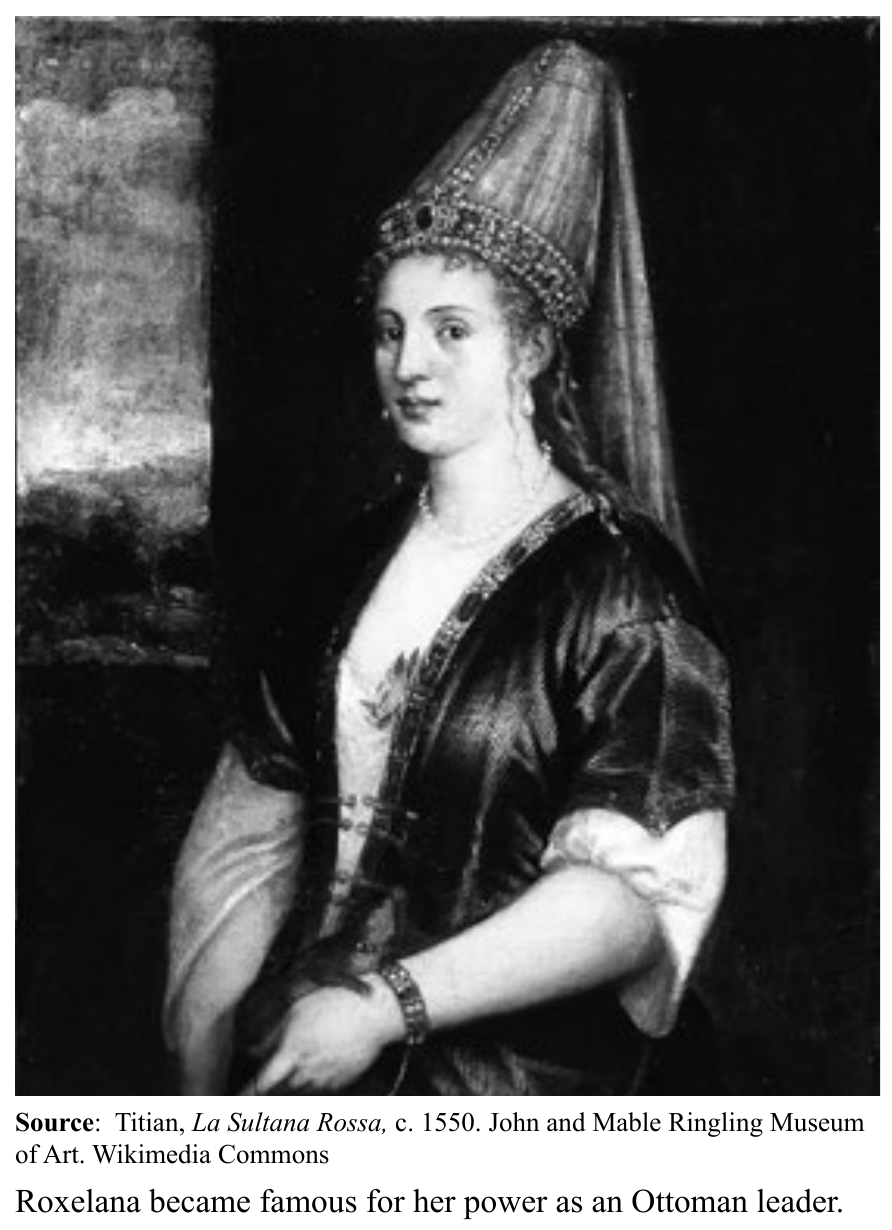
One woman, Roxelana, became unusually powerful in the Ottoman Empire. When she was a young girl, Crimean raiders stole Roxelana from her home in Eastern Europe and sold her into slavery in the Ottoman Empire. She was forced to convert to Islam and entered the harem of Suleiman the Magnificent, sultan of the empire. Suleiman was notable for his military and administrative skill. Suleiman married Roxelana, which was highly unusual. She went from being enslaved to commissioning ambitious public works projects.
Roxelana’s son succeeded Suleiman. During the son’s reign, viziers complained about a “sultanate of the women.” They believed members of the harem had too much influence on politics. Roxelana’s rise showed that it was possible—though rare—for people at this time to attain a different social class.
Other Social Classes Merchants and artisans formed a small middle class in the empire. Below the middle class were the peasants, who were usually poor—particularly because they had to pay tribute to the government
support to help
the Ottoman armies. Below the peasants were
the enslaved. They came from many areas as the Ottoman armies penetrated Central and Eastern Europe, capturing prisoners of war in Ukraine and elsewhere. Barbary pirates, those who plied the seas near North Africa along the Barbary Coast
(named
the Berbers who for lived
captured
there) other Europeans in the Mediterranean and then sold them to the sultan or other high-ranking officials. Some people were
or
impressed, forced into service, in the navy as enslaved galley workers. As many as
one million people were impressed between the 16th and 19th centuries.